


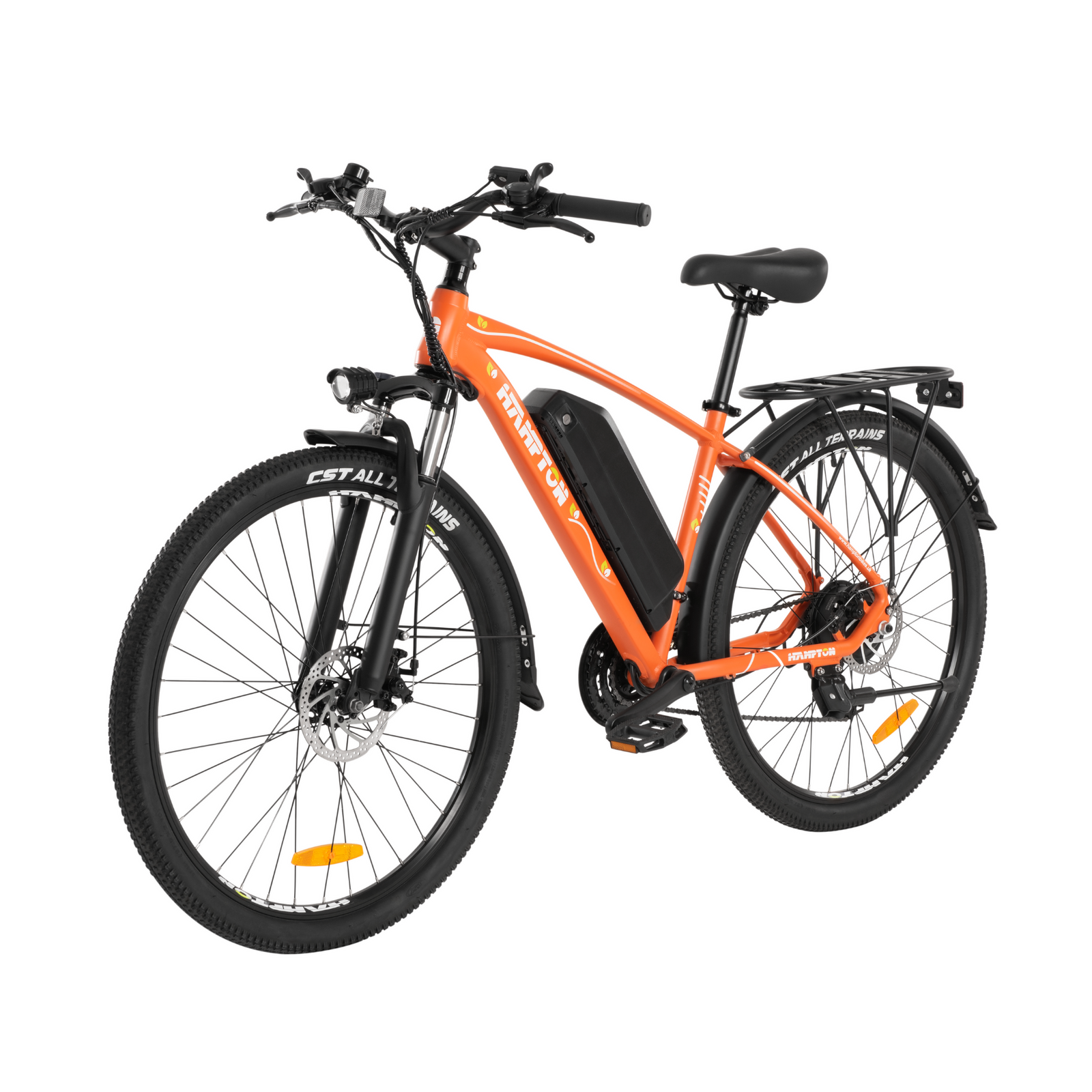


Last updated: July 2026
Electric bikes are increasingly common in the UK, but not every product advertised as an e-bike can legally be used on public roads and cycle lanes like an ordinary bicycle.
The important question is whether the bike qualifies as an EAPC—an Electrically Assisted Pedal Cycle. A compliant EAPC is treated broadly like a conventional pedal cycle. An electric bike outside this category is generally treated as a motorcycle or moped instead.
What makes an electric bike road legal in Great Britain?
They must propel the bike
Decorative or unusable pedals are not sufficient. The pedals must be capable of moving the bike.
Maximum 250W continuous power
The legal test concerns maximum continuous rated motor power, not merely an advertised peak figure.
Motor assistance stops at 15.5 mph
You may pedal faster or gain speed downhill, but the motor must not continue propelling the bike above the cut-off.
The rider must be 14 or older
A person under 14 cannot legally ride an EAPC in Great Britain.
No licence, registration or motor insurance
A compliant EAPC does not need vehicle registration, vehicle tax or compulsory motor insurance.
Where ordinary cycles are permitted
This includes public roads and cycle routes, but not ordinary pavements or pedestrian-only footways.
1. What is an EAPC?
EAPC stands for Electrically Assisted Pedal Cycle. It is the legal classification that allows an electric bike to be treated broadly like a conventional pedal cycle.
An EAPC:
- must have pedals that can be used to propel it
- may have more than two wheels, such as an electric tricycle
- must have a motor with a maximum continuous rated power of no more than 250W
- must stop providing motor assistance at 15.5 mph (25 km/h)
The 15.5 mph limit applies to motor assistance, not the bike’s absolute speed. A rider can travel faster by pedalling or going downhill, provided the motor is no longer assisting above the legal cut-off.
2. What does “250W continuous rated power” mean?
The legal threshold is based on the motor’s maximum continuous rated power. This is not necessarily the same as the highest short-term or “peak” number used in advertising.
A motor may briefly produce more power when starting or climbing. A peak-power claim by itself does not prove whether the bike is or is not a compliant EAPC. Check:
- the stated continuous motor rating
- the permanent markings on the bike
- the assistance cut-off speed
- the way any throttle operates
- the bike’s approval documentation, where applicable
3. Do you need a licence, insurance or registration?
If the bike is a compliant EAPC, you do not need:
- a driving licence
- vehicle registration
- vehicle tax
- compulsory motor insurance
The rider must be at least 14 years old.
The Highway Code says cyclists should wear a correctly fitted cycle helmet that conforms to current regulations. A helmet is strongly recommended even though an ordinary EAPC is not subject to the motorcycle-helmet requirement.
4. Where can you ride a road-legal e-bike?
A compliant EAPC can generally be ridden anywhere ordinary pedal cycles are permitted, including:
- public roads
- cycle lanes
- cycle tracks and cycle paths
- shared-use routes where cycling is permitted
You cannot ride it on an ordinary pavement or pedestrian-only footway. Where a route is divided between cyclists and pedestrians, keep to the part designated for cycling.
5. Are throttle-powered e-bikes legal?
A throttle does not automatically make an electric bike illegal, but throttle operation is one of the most commonly misunderstood parts of UK e-bike law.
A walk-assist function that moves the bike without pedalling and cuts off at approximately 3.7 mph (6 km/h) is outside the scope of vehicle type approval.
A “twist and go” e-bike capable of providing assistance without pedalling above walk-assist speed can require vehicle approval. GOV.UK says an electric bike that can propel itself up to 15.5 mph without pedalling must be approved.
For twist-and-go EAPCs placed on the market or entering service after 1 January 2016, the necessary technical approval is normally arranged by the manufacturer or importer. An approved bike should have an approval number.
If a qualifying vehicle has not been type-approved, an importer or individual may be able to apply for Motorcycle Single Vehicle Approval.
6. What markings must a legal EAPC display?
A compliant EAPC must display important information clearly and durably.
GOV.UK says the bike’s markings must identify:
- the manufacturer
- the motor’s maximum continuous rated power
The markings must also show either the battery voltage or the maximum speed at which the motor can propel the bike, depending on how the information is displayed.
Missing, removable, unclear or contradictory markings should be treated as a warning sign when assessing a bike advertised as road legal.
7. What lights, reflectors and brakes are required?
The lighting requirements for EAPCs are the same as those for ordinary pedal cycles.
When an EAPC is used on a public road between sunset and sunrise, it must have:
- a white front light
- a red rear light
- a red rear reflector
- amber reflectors on the front and rear edges of each pedal, subject to the applicable manufacturing-date rules
The brakes must meet the applicable cycle requirements and be maintained in efficient working order. Worn brake pads, loose controls, damaged tyres or poor maintenance can make an otherwise compliant bike unsafe to ride.
8. What happens when an electric bike is not an EAPC?
An electric bike falls outside the EAPC category if, for example, it:
- has a maximum continuous rated motor power above 250W
- can be propelled by its motor above 15.5 mph
- does not have pedals capable of propelling it
Such a vehicle is generally treated as a motorcycle or moped rather than as an ordinary bicycle.
For lawful public-road use, it would normally need the appropriate vehicle approval, registration, tax and insurance. The rider would also need the correct driving licence and an approved motorcycle helmet.
A non-EAPC cannot be used in cycle lanes or on cycle tracks as though it were an ordinary bicycle. If it has not met the relevant motor-vehicle requirements, it should only be used on private land with the landowner’s permission.
9. Does an “off-road mode” preserve EAPC status?
No. Marketing language does not change a vehicle’s legal classification.
Department for Transport guidance states that electric cycles with an “off-road” mode that allows the motor to propel the vehicle above 15.5 mph do not, in its view, comply with the EAPC regulations and are considered motor vehicles.
A temporary setting, unlock code, app restriction or switchable speed mode should therefore not be assumed to make a higher-powered bike an EAPC on public roads.
10. Did the UK increase the EAPC motor limit to 500W?
No. The standard limit remains 250W maximum continuous rated power.
In 2024, the Department for Transport consulted on proposals to:
- increase the maximum continuous rated motor power from 250W to 500W
- allow twist-and-go throttle assistance up to 15.5 mph without type approval
In January 2025, the government confirmed that it would not take those proposals forward. The existing 250W and 15.5 mph EAPC framework therefore remains in place.
11. What about e-bike conversion kits?
Converting an ordinary bicycle does not avoid the EAPC rules. The completed bike must be assessed by its final specification and operation.
Before fitting or buying a conversion kit, check:
- the motor’s maximum continuous rated power
- the speed at which assistance cuts off
- whether the pedals still propel the bike
- whether a throttle provides power without pedalling
- whether vehicle approval is required
- whether the bicycle’s frame, fork and brakes are suitable for the additional weight and forces
- whether the battery and charger are compatible and supplied by a reputable source
Unauthorised modifications can also affect product warranties, insurance cover and the safety of the bicycle’s electrical and mechanical systems.
12. Road-legal e-bike checklist
Before buying or using an e-bike on public roads, work through these checks:
- It has pedals capable of propelling the bike.
- The maximum continuous rated motor power is 250W or less.
- Motor assistance stops at 15.5 mph.
- The manufacturer and required technical information are marked on the bike.
- Any throttle-only operation has the necessary approval.
- The brakes, tyres, lights and reflectors are suitable and properly maintained.
- The battery and charger are compatible, undamaged and used according to the manufacturer’s instructions.
Battery safety is a separate responsibility
Road legality and battery safety are separate issues. A legally classified EAPC can still become dangerous if it is damaged, badly maintained or charged incorrectly.
- Use only the charger supplied or specifically approved for the battery.
- Do not charge a battery that is swollen, leaking, crushed, unusually hot or physically damaged.
- Do not charge in a hallway, stairway or anywhere that blocks an escape route.
- Avoid incompatible replacement batteries, modified wiring and unqualified repairs.
- Follow the manufacturer’s inspection, charging and storage instructions.
Choosing an electric bike?
Check the continuous motor rating, assistance cut-off, markings, intended use and after-sales support—not just the headline power or speed claim.
Final thoughts
“Electric bike” is a broad retail description. EAPC is the important legal category for normal road and cycle-route use in Great Britain.
Look for functional pedals, a maximum continuous rated motor power of no more than 250W, assistance that stops at 15.5 mph and the required markings. If the bike has a throttle, an unlockable higher-speed mode or unclear power information, investigate its approval and legal classification before using it in public.
Higher-powered electric bikes are not necessarily illegal to own, but they are not treated like ordinary bicycles. Public-road use requires compliance with the relevant motor-vehicle rules.
This article provides general information and is not legal advice. Regulations and official guidance can change. Check the latest government guidance or obtain independent advice if you are uncertain about a particular bicycle, conversion or intended use.
Frequently Asked Questions
Is a 250W e-bike automatically road legal?
No. The continuous motor rating is only one requirement. The bike must also have usable pedals, stop providing motor assistance at 15.5 mph and comply with the other applicable EAPC requirements.
Can I ride a 500W or 750W e-bike on UK roads?
Not as an ordinary EAPC if that figure is the motor’s maximum continuous rated power. Public-road use would normally require compliance with the relevant motorcycle or moped requirements. If the figure is only an advertised peak output, check the continuous rating and the bike’s complete specification.
Does peak motor power determine whether an e-bike is legal?
Not by itself. The EAPC power threshold concerns maximum continuous rated power. You must also consider the assistance cut-off, pedals, throttle operation, markings and any approval requirements.
Can I ride a legal e-bike on a cycle path?
Yes. A compliant EAPC can generally be used on cycle paths and anywhere else ordinary pedal cycles are permitted.
Can I ride an e-bike on the pavement?
Not on an ordinary pavement or pedestrian-only footway. Cycling is permitted only where the route has been designated for cycles or shared use.
Are throttle e-bikes illegal?
Not automatically. Walk-assist operation up to approximately 3.7 mph is treated differently from throttle-only propulsion at higher speeds. A twist-and-go e-bike capable of moving without pedalling may require type approval.
Do I need insurance for an electric bike?
Compulsory motor insurance is not required for a compliant EAPC. A bike outside the EAPC rules is generally treated as a motor vehicle and must meet the corresponding insurance and registration requirements before public-road use.
Do I need to wear a helmet?
The Highway Code says cyclists should wear a correctly fitted cycle helmet. If the vehicle is classified as a motorcycle or moped rather than an EAPC, an approved motorcycle helmet is required.


