


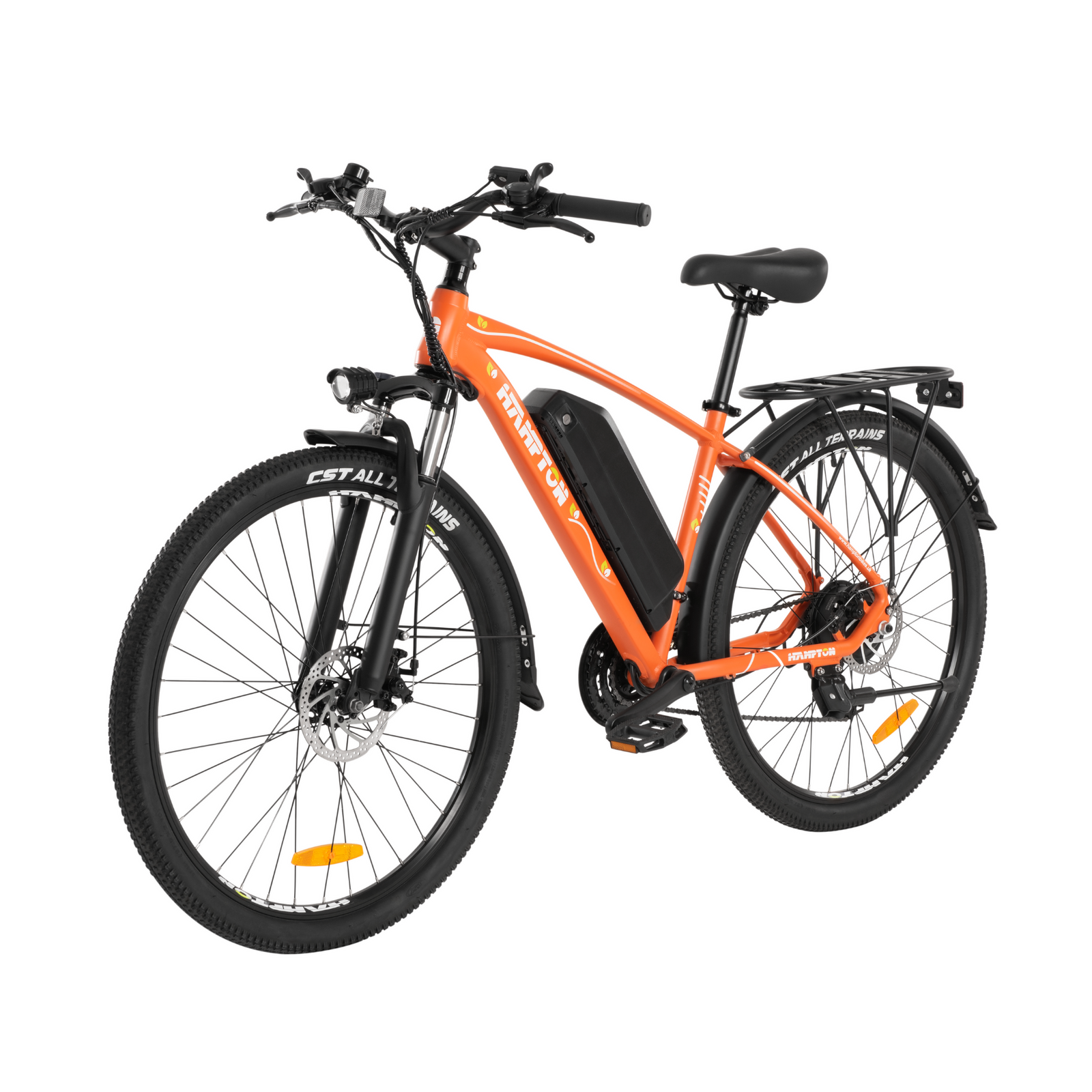


Electric bikes are becoming an increasingly familiar sight across the UK. Commuters use them to make longer journeys more manageable, leisure riders use them to tackle hills, and people returning to cycling value the additional support provided by the motor.
The attraction is not simply speed. For most riders, an e-bike is valuable because it removes some of the obstacles that make conventional cycling difficult to fit into everyday life.
From conversations with customers in our London shop and workshop, the same priorities appear repeatedly: riders want help on hills, a more comfortable commute, practical range and a bike they will genuinely use regularly.
Quick takeaway: An electric bike does not do everything for you. It provides controlled assistance that makes hills, distance, headwinds and heavier loads easier to manage—helping more people cycle more often.
If you are already considering an e-bike, read our practical UK electric-bike buying guide to compare bike types, motors, batteries and real-world range.
Last reviewed: 27 July 2026
1. Hills become much more manageable
Hills are one of the most common reasons people avoid cycling regularly. Even a relatively short incline can make a commute feel demanding, especially when carrying a bag or riding home after a long day.
An electric bike uses a motor to support your pedalling. Depending on the bike and assistance level selected, this can significantly reduce the effort required to climb.
You still need to choose the correct gear and pedal sensibly. Still, the assistance can make the difference between approaching a hill confidently and planning an entirely different route to avoid it.
2. Commuting becomes more realistic
A standard bicycle can be an excellent commuting option, but distance, hills, headwinds and the prospect of arriving tired can discourage people from using one every day.
An e-bike can make the effort more predictable. Riders can increase the assistance on difficult sections and reduce it when conditions are easier. This makes it possible to arrive feeling fresher without removing cycling from the journey.
E-bikes can be particularly useful for commuters who:
- travel further than they would comfortably cycle on a conventional bike
- encounter hills or repeated stop-start traffic
- carry work equipment or a heavy backpack
- want to reduce their dependence on a car
- need a folding bike for mixed-mode journeys
A folding electric bike can also be easier to store at home or work. Before combining it with public transport, check the operator's current rules because restrictions can apply to certain e-bikes.
3. Longer journeys feel achievable
Electric assistance changes how many riders perceive distance. A journey that feels slightly too long on a standard bicycle may become a practical everyday route on an e-bike.
This can expand the number of destinations reachable without a car, including workplaces, shops, railway stations and leisure routes.
However, manufacturer range figures should always be treated as estimates. Real-world range depends on:
- battery capacity and condition
- assistance level
- rider and luggage weight
- hills and road surface
- headwinds and temperature
- tyre pressure
- riding style
- the number of stops and starts
For practical buying advice, choose a battery with a sensible reserve rather than selecting a bike whose maximum advertised range only covers your planned journey.
4. E-bikes make cycling accessible to more people
Not everyone approaches cycling with the same fitness, confidence or experience. Some riders are returning after many years away, while others live in hilly areas or want to reduce the physical effort required for everyday travel.
Electric assistance allows the rider to decide how much support is needed. A lower setting can provide gentle help, while a higher setting can make a demanding section easier to complete.
This does not mean an e-bike removes every physical requirement. Riders still need sufficient balance, awareness and control for the bike they choose. Electric bikes are also generally heavier than conventional bicycles, which matters when lifting, carrying or storing one.
5. You still pedal and remain active
On most road-legal pedal-assist e-bikes, you still pedal while the motor supports your effort. Certain approved "twist and go" models are an exception, but the standard EAPC experience is pedal assistance rather than motor-only propulsion.
The rider remains responsible for steering, braking, gear selection and controlling the bike. Assistance reduces the amount of effort needed in more demanding situations.
For many people, the realistic comparison is not between riding an e-bike and riding a conventional bicycle for the same distance. It is between using an e-bike and not cycling at all.
6. Everyday running costs can be lower
An electric bike costs more to buy than many conventional bicycles, but its everyday running costs can be considerably lower than those of a car.
You still need to budget for:
- electricity for charging
- tyres and inner tubes
- brake pads and servicing
- chains, cassettes or belts where applicable
- battery replacement later in the bike's life
- security equipment and optional insurance
Nevertheless, charging an e-bike requires relatively little electricity. There are also no normal fuel costs, vehicle tax or mandatory motor insurance requirements when the bike qualifies as an EAPC.
The largest savings are usually achieved when the e-bike replaces journeys that would otherwise be made by car, taxi or public transport.
7. Carrying shopping and equipment becomes easier
The motor does not only assist the rider—it also helps compensate for additional weight.
Shopping, work equipment, panniers and appropriately fitted child-carrying equipment can all make a conventional bike feel substantially heavier, particularly when starting or climbing.
Electric assistance makes utility cycling more practical, which is one reason step-through, cargo and long-tail e-bikes have become attractive alternatives for everyday transport.
Always check the manufacturer's maximum permitted load and use luggage equipment designed for the particular bicycle. Weight should be secured and distributed safely rather than hung loosely from the handlebars.
8. Headwinds and difficult conditions are less discouraging
A strong headwind can make a flat route feel like a continuous climb. Repeated junctions and stop-start traffic can also make an otherwise short journey tiring.
An e-bike cannot remove poor weather, traffic or difficult road conditions, but it can reduce the additional effort they create.
This makes journey times and physical effort more consistent. That predictability is particularly useful for commuting, where riders need to know that the return journey will remain manageable even if conditions change.
9. Some short car journeys can be replaced
An electric bike will not replace every car journey. It is unlikely to be the right option for carrying several passengers, transporting very large loads or making journeys where safe cycling infrastructure is unavailable.
However, it may replace some short and medium-distance trips, particularly:
- travelling to work
- visiting local shops
- reaching a railway station
- attending appointments
- school or nursery journeys with suitable equipment
- local leisure and social trips
The change is often gradual. Owners do not necessarily stop using a car completely; they discover that more everyday journeys are practical by bike than they previously expected.
10. Modern e-bikes offer far more choice
Electric bikes are no longer limited to one heavy, utility-focused design. Riders can now choose from several distinct categories:
- Folding e-bikes: Compact storage and mixed-mode travel.
- Step-through e-bikes: Easier mounting and a comfortable upright position.
- Hybrid and commuter e-bikes: Everyday road, cycle-path and light leisure use.
- Electric mountain bikes: Off-road riding and demanding terrain.
- Fat-tyre e-bikes: Additional tyre volume and stability on suitable surfaces.
- Cargo e-bikes: Carrying shopping, equipment or family loads.
- Road-style e-bikes: Lower weight and a sportier riding position.
The best option depends on where the bike will be used, how it will be stored and what the rider values most. Motor wattage and headline range should not be the only considerations.
11. E-bikes can be easier to use consistently
The most important benefit may be simple consistency.
A conventional bicycle can remain unused when the rider is tired, the weather is windy, or the return journey includes a difficult hill. Electric assistance lowers these barriers.
A bike that is comfortable, practical and appropriate for its owner is more likely to be used regularly. That is more valuable than buying a model with impressive specifications that does not suit the rider's actual journeys.
Understanding the UK legal requirements
In Great Britain, an electric bike must qualify as an Electrically Assisted Pedal Cycle or EAPC to be used broadly like a normal bicycle.
In general, an EAPC must:
- have pedals capable of propelling the bike
- use a motor with a maximum continuous rated power of no more than 250W
- stop providing electrical assistance at 15.5 mph (25 km/h)
The minimum age for riding an EAPC is 14. A compliant EAPC does not normally require vehicle registration, vehicle tax, motor insurance or a driving licence.
Motor-only throttle operation above walking speed requires additional attention. GOV.UK states that a bike may propel the rider up to 15.5 mph without pedalling only when it has the necessary approval.
Important: A bike advertised as an "e-bike" is not automatically road legal. High-powered, unlocked or unapproved throttle-controlled models may be treated as motor vehicles. Read our complete UK e-bike laws guide before buying.
When an electric bike may not be the right choice
An e-bike has many advantages, but it is not automatically the best option for every rider.
Consider the following limitations:
- Higher purchase price: Motors, batteries and control electronics add cost.
- Additional weight: Many e-bikes are difficult to carry upstairs or lift into a vehicle.
- More complex repairs: Electrical faults may require specialist diagnosis and model-specific parts.
- Battery ageing: Lithium-ion batteries gradually lose capacity and will eventually require replacement.
- Security: E-bikes can be attractive theft targets and require strong locks and sensible storage.
- Charging access: The battery must be charged and stored in accordance with the manufacturer's instructions.
- Transport restrictions: Some rail and public-transport operators restrict particular e-bike types.
Battery quality and after-sales support are particularly important. Very cheap replacement batteries, incompatible chargers and poorly manufactured conversion kits can create reliability and safety risks.
Read our guides to e-bike battery lifespan and e-bike and e-scooter battery fire safety before charging or replacing a battery.
Is an electric bike right for you?
An e-bike may be a good choice if you:
- want assistance on hills or into headwinds
- have a commute that feels slightly too long for a conventional bike
- want to arrive with less physical strain
- plan to carry shopping or equipment
- are returning to cycling after a long break
- want to replace some short car journeys
- have secure storage and a suitable charging location
Before choosing a model, consider:
- your typical journey length
- terrain and local hills
- rider and luggage weight
- whether the bike must be folded or carried
- battery range under realistic conditions
- availability of replacement parts
- warranty and repair support
- whether the bike complies with UK road-use rules
Final thoughts
The appeal of an electric bike is not that it eliminates cycling effort or turns a bicycle into a motorcycle. Its value comes from making ordinary cycling more practical.
Hills become easier, longer journeys become achievable and heavy loads become more manageable. Riders can remain active while choosing the level of assistance appropriate for the journey.
For some people, an e-bike provides a comfortable return to cycling. For others, it offers a realistic alternative for commuting and local travel. The best reason to choose one is not fashion or a headline specification—it is that the bike suits your life well enough to be used regularly.
Ready to Find the Right Electric Bike?
Explore our range of folding, commuter, step-through and all-terrain electric bikes, with UK support from Electric Scooters London.
SHOP ELECTRIC BIKESFrequently Asked Questions
Are electric bikes good for commuting?
Yes, particularly when a journey includes hills, headwinds, longer distances or repeated stop-start riding. Choose a bike with suitable range, reliable brakes, appropriate tyres and a practical method of carrying luggage.
Do you still have to pedal an electric bike?
On most road-legal EAPCs, the motor assists while you pedal. Some approved "twist and go" e-bikes can assist without pedalling, but approval status is important.
How fast can a road-legal electric bike go in the UK?
The bike can travel faster than 15.5 mph, but electrical assistance must stop at 15.5 mph for a standard EAPC. Any additional speed must come from the rider, gravity or momentum.
Do I need a licence or insurance?
Not for a compliant EAPC. If the bike falls outside the EAPC requirements, it may be treated as a motor vehicle and different registration, licensing, insurance and helmet requirements can apply.
Are electric bikes expensive to charge?
Charging costs are normally modest because an e-bike battery stores much less energy than an electric-car battery. The exact cost depends on the battery capacity, charging losses and your electricity tariff.
Can an electric bike replace a car?
It can replace some short and medium-distance journeys, but probably not every journey. Its suitability depends on distance, local infrastructure, weather, passenger requirements and the amount of luggage being carried.
How long does an e-bike battery last?
Battery lifespan depends on cell quality, charging habits, temperature, storage, usage and the battery-management system. Capacity gradually declines with age and charge cycles, even when the battery is properly maintained.
This article provides general buying and legal information. Product specifications and transport rules can change, so check the manufacturer's documentation and current official guidance before purchasing or riding.


